
Speak: Language Learning
Speakeasy LabsEducation
4.88.81K Reviews
- Version
- 4.74.0
- Installs
- 10.00M
- Age Rating
- Everyone
Screenshots

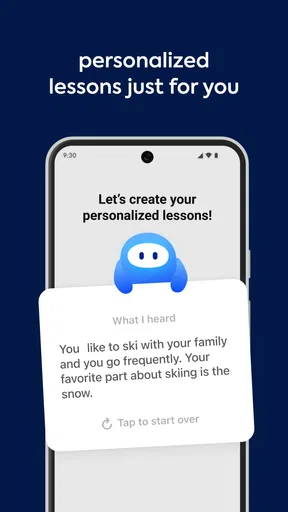
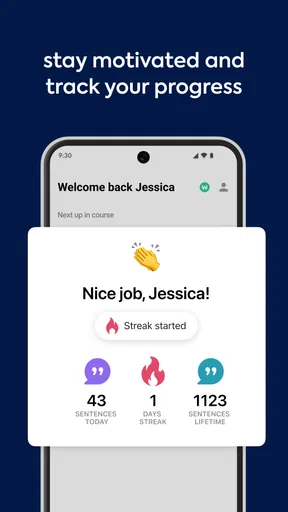

Our Review of Speak: Language Learning
 Analysis by Appyee
I tend to learn a language best when I have to produce a sentence, not just recognize one on a screen. That is the idea behind Speak: Language Learning: it is an education app from Speakeasy Labs that puts spoken practice at the center. Its focus is a good fit if you already know a few words but freeze when it is time to say them aloud. It covers Spanish, French, English, and Japanese, so the first practical question is whether one of those matches what you want to learn.
There is a useful distinction between practicing a conversation and being ready for every conversation outside the app. Speak can help you rehearse common exchanges and get more comfortable forming spoken responses, but it is not a substitute for listening to many different speakers, reading, or talking with people who can take a conversation in unexpected directions. I see it as a speaking practice tool within a broader routine, rather than a complete language course by itself.
What speaking practice feels like
Right off the bat, the interface of Speak: Language Learning is sleek and intuitive. It doesn’t throw a million options at you, which is something I really appreciate. You can dive straight into learning without getting lost in a sea of menus. The design is easy on the eyes, with a clean layout that makes navigation a breeze.
Conversation practice, not just recognition
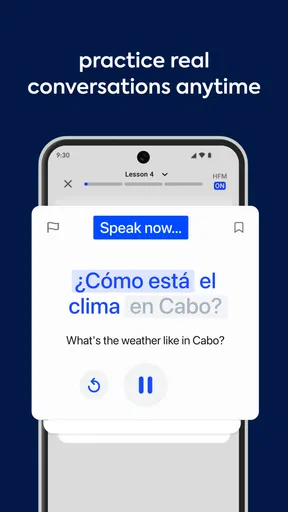
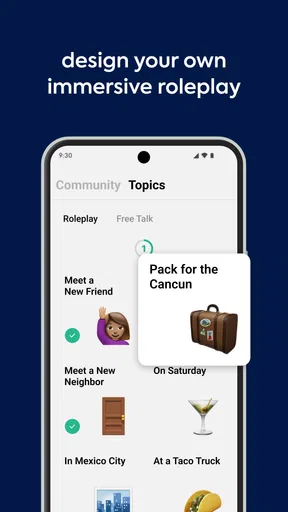
The app offers a variety of features aimed at enhancing your language skills. You’ve got everything from vocabulary building games to real-life conversation practice. One of my favorite features is the interactive dialogues. You get to practice speaking in scenarios that you’d actually encounter, like ordering a coffee or asking for directions. It’s super practical!
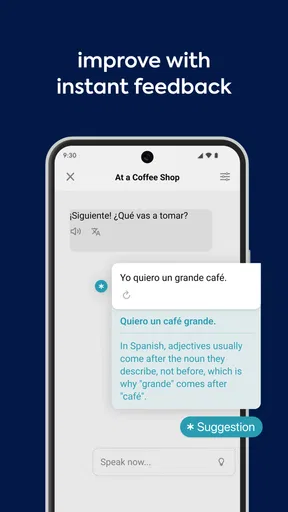
Another cool thing is the speech recognition technology. It gives you feedback on your pronunciation, which is crucial when you’re trying to sound like a native. I found this feature pretty accurate, and it’s definitely a confidence booster.
For a more useful practice session, I would treat a dialogue as a rehearsal rather than a script to memorize. Say the response aloud, notice where pronunciation feedback points you, then try the line again with a different emphasis or a more natural pace. That small change can help reveal whether you understand the sentence or have only learned to repeat its sound. Speech recognition is helpful, but it cannot judge every part of communication: a recognized phrase is not necessarily fluent, well-timed, or appropriate in every real-world setting.
Making a routine that survives busy days
One of the things that sets this app apart is its flexibility. Whether you’re a total beginner or looking to polish your skills, there’s something for everyone. The lessons are bite-sized, so you can squeeze in a quick session during your coffee break or commute. Plus, the app tracks your progress, so you get to see how far you’ve come, which is super motivating.
A realistic way I’d use it is to practice a short exchange before a specific event: asking for a table before meeting friends at a restaurant, or checking how to ask for directions before heading into an unfamiliar neighborhood. The point is not to assume the exact dialogue will happen, but to have a few sentence patterns ready so I am less likely to go quiet. After the session, I would try to recall the same idea without looking at the prompt. That extra retrieval step makes practice more demanding and gives me a clearer sense of what I can actually say.
On a commute, the best moment to practice depends on the setting. Speaking aloud can be awkward on a crowded bus or train, and a noisy environment may make spoken exercises less comfortable. I would save those sessions for a private moment, a quiet walk, or a break where I can answer at a normal volume. If I only have a few minutes in public, reviewing what I want to practice next can be a better use of that time than trying to force a speaking session into an unsuitable place.
Connectivity changes the shape of a session
Because the central activity involves speaking and receiving feedback, a reliable connection is a sensible part of planning a session. I would not start a longer practice round in a place where service is likely to drop, especially if I am relying on the app to respond as I speak. On a stable connection, the interaction can feel like a focused rehearsal; when the network is unreliable, interruptions can break concentration and make it harder to judge how smoothly a sentence went.
That makes this a different kind of mobile learning from a reader or a set of flashcards that can be used silently in almost any spare moment. Before leaving home, I would open the app and make sure I am ready to practice while I have a dependable connection, rather than assume every exercise will work without one. For travel, I would also keep a separate plan for studying vocabulary or listening to language material from resources that I already know are available in the setting I will be in.
If a session stalls, I would pause rather than repeat the same phrase over and over while the connection is struggling. Check whether the phone has service, wait for the network to settle, then try a short response again. If the app still does not react as expected, closing and reopening it is a reasonable basic recovery step; I would avoid assuming that a missed response means my pronunciation was wrong. Separating a technical hiccup from a language mistake matters, because otherwise a learner can lose confidence for the wrong reason.
For data-conscious use, spoken practice is worth treating differently from reading text. I would prefer Wi-Fi for longer sessions when convenient, and keep mobile practice brief if I am trying to conserve data. This is a general planning choice, not a claim about a particular data allowance or an offline mode. The same approach also helps preserve attention: a focused session with a few deliberate spoken attempts is often more valuable than leaving the app open while doing other things.
Who gets the most from it
This approach should suit learners who want to get past the hesitation of speaking, especially people who have studied vocabulary or grammar but need a low-pressure place to say sentences aloud. It can also be useful for someone preparing for routine interactions on a trip or building confidence before a class or conversation exchange. The supported languages include Spanish, French, English, and Japanese, so it is worth checking that your target language is among them before you build a study habit around the app.
I would be more cautious about recommending it as the only resource to a learner who needs detailed grammar explanations, extensive reading practice, or exposure to a wide range of accents and spontaneous conversation. A structured textbook or grammar-focused course can be better for understanding why a sentence works; a tutor or language exchange can better prepare you for the unpredictability of another person. The strongest role for Speak is to complement those options by giving you repeated chances to form spoken replies.
Compared with the usual vocabulary-first learning apps, the emphasis here is less about collecting words and more about using language aloud. That makes it a useful alternative if you already recognize familiar expressions but struggle to retrieve them quickly. It is not necessarily the better choice for everyone: learners who prefer quiet study, detailed written explanations, or self-directed review may find a flashcard system or a conventional course more comfortable. I would choose based on the skill I most need to practice, rather than expecting one app to cover every part of language learning equally well.
Community, support, and useful expectations
Learning a language can be daunting, but the community aspect of the app makes it more engaging. You can interact with other learners, participate in challenges, and even compete on leaderboards. This social element adds a fun twist to the learning process.
If you ever get stuck, the app offers plenty of resources and support. There’s a help section, FAQs, and even a way to contact support directly. They’ve really thought of everything to ensure you’re never left hanging.
Social features can help make a routine feel less solitary, but I would treat a leaderboard as encouragement rather than a measure of speaking ability. A streak or challenge can show that I returned to practice; it cannot tell me whether I can handle a conversation without prompts. A more meaningful personal check is whether I can answer a familiar question in my own words, then recover when I forget a word. That is a practical goal to keep in mind alongside the app’s progress tracking.
The app is free to download, with in-app purchases ranging from $14.99 to $349.99 per item. I would explore the experience and decide whether its spoken-practice style fits me before considering any paid option. That is especially sensible if I am still unsure whether I will make time to speak regularly. Its average rating is 4.7 from around 99,000 ratings, and it has over 5 million installs, which suggests a substantial audience, though those figures do not guarantee that its teaching style will suit every learner.
A practical verdict on using it
Overall, Speak: Language Learning is a fantastic tool for anyone looking to master a new language. It’s user-friendly, packed with features, and adaptable to your learning style. Whether you’re brushing up on rusty skills or starting from scratch, this app's got you covered. So, why not give it a shot? You might just surprise yourself with how quickly you pick up a new language!
My more measured recommendation is to use it for a specific job: getting comfortable speaking the language you are studying. It is rated for Everyone, and version 4.26.0 is listed for devices running Android 8.0 or later. If you have an older Android device, that minimum matters before you plan on installing it. The app is available on Android and iOS, but the exact experience can vary by device and connection, so I would try a short session in the place where I expect to use it most.
For a learner who can commit to brief, attentive practice and has a dependable connection when speaking, the conversational format is a clear reason to give it a try. If connectivity is often poor, speaking in public is uncomfortable, or your main need is deep grammar instruction, another resource may serve you better as a primary tool. I would pair this app with listening and real conversation when possible, then use its dialogues to rehearse the moments that currently make me hesitate. That makes its strengths useful without asking it to do a job it was not designed to do.
Privacy and Permissions
See what permissions an app requests and how it handles your data.
- Photos/Media/Files
- read the contents of your USB storage, modify or delete the contents of your USB storage
- Storage
- read the contents of your USB storage, modify or delete the contents of your USB storage
- Microphone
- record audio
- Wi-Fi connection information
- view Wi-Fi connections
- Other
- view network connections, pair with Bluetooth devices, full network access, change your audio settings, run at startup, control vibration, prevent device from sleeping, read Google service configuration
Verdict
Strengths of Speak: Language Learning
- User-friendly interface, easy to navigate.
- Wide range of languages available.
- Interactive lessons enhance learning.
- Offline mode for learning on-the-go.
- Regular updates with new content.
Limitations of Speak: Language Learning
- Limited free content, requires subscription.
- Occasional app crashes reported.
- Pronunciation tool needs improvement.
- Some languages lack advanced levels.
- In-app purchases can be pricey.
Similar Picks in This Category
View All
Duolingo: Language Lessons
Duolingo4.7

Google Classroom
Google LLC2.8

Unacademy: Learn & Crack Exams
Unacademy3.2

Bible App for Kids
Life.Church4.4

Cake - Learn English & Korean
Cake Corp.4.7

Brainly: AI Homework Helper
Brainly4.5
Frequently Asked Questions
How does Speak: Language Learning help improve my language skills?
Speak: Language Learning uses interactive lessons, real-life scenarios, and speech recognition technology to help you practice speaking, listening, and comprehension skills. The app offers personalized feedback and tracks your progress, making it easy to see improvements over time. This approach ensures that you learn in a practical, engaging, and effective manner.
What languages are available to learn on Speak?
Speak: Language Learning offers a wide variety of languages to choose from, including popular options like Spanish, French, Mandarin, and German. The app continually updates its language offerings, so users can explore new languages and find the one that best suits their learning goals and interests.
Is Speak suitable for beginners, or is it better for advanced learners?
Speak is designed to cater to all levels of learners, from beginners to advanced. The app starts with foundational vocabulary and grammar for newcomers and offers progressively challenging content for more advanced users. This adaptability ensures that learners at any stage can benefit from the app's resources.
Can I use Speak offline, or do I need an internet connection?
Speak allows users to download lessons for offline use, making it convenient to practice language skills without a constant internet connection. This feature is especially useful for learners who travel frequently or have limited access to Wi-Fi, ensuring uninterrupted learning on the go.
Does Speak offer any cultural insights or context for the languages taught?
Yes, Speak includes cultural notes and context within its lessons to enhance understanding and appreciation of the language. These insights help learners grasp not only the linguistic aspects but also the cultural nuances, making the learning experience more holistic and enriching.
